Part of the Harford County Committee of the Maryland Lynching Memorial Project’s effort to commemorate the lives of three men known to have been lynched in Harford County involves collecting jars of soil from the lynching sites. Some of these soil samples will be sent to the Legacy Museum in Montgomery, Alabama to be placed alongside soil collected from lynching sites around the country in a memorial display for the thousands of victims of racial terror lynching in the United States. Other soil collection jars will remain in Harford County to be displayed locally. The Soil Collection and Remembrance Ceremony scheduled for March 28, 2020 in Bel Air was postponed due to the Covid 19 outbreak, but will be rescheduled once it is determined to be safe again to hold public gatherings. While it is not essential, or even possible, to gather soil from the exact spots where the lynchings occurred, we feel it is important to come as close as we can, both to maintain historical accuracy and to honor these men.
In Harford County, our researchers have used a variety of sources to try to pinpoint these sites. Historically, some lynchings were conducted in relative secrecy, but others took place quite publicly, often in broad daylight with crowds of onlookers. Newspapers and witnesses often left detailed descriptions of the events and their locations. However, unless there are physical landmarks still intact at those sites, it can be difficult to determine the location accurately from the descriptions alone. One very helpful tool has been the use of historic maps, especially those from the 1800s. In Harford County, the Jennings and Herrick map from 1858, the Martenet’s map from 1878, election maps from the 1920s, and fire insurance maps from the 1930’s have all proven useful, especially when compared with early aerial photographic surveys of the county, particularly those from 1938 and 1952. Landmarks provided by descriptions of the events can often still be seen using these sources, even though they may have since disappeared due to development in the county. The process of utilizing various sources to corroborate first person descriptions is a good historical research technique, which helps confirm the validity of our findings.
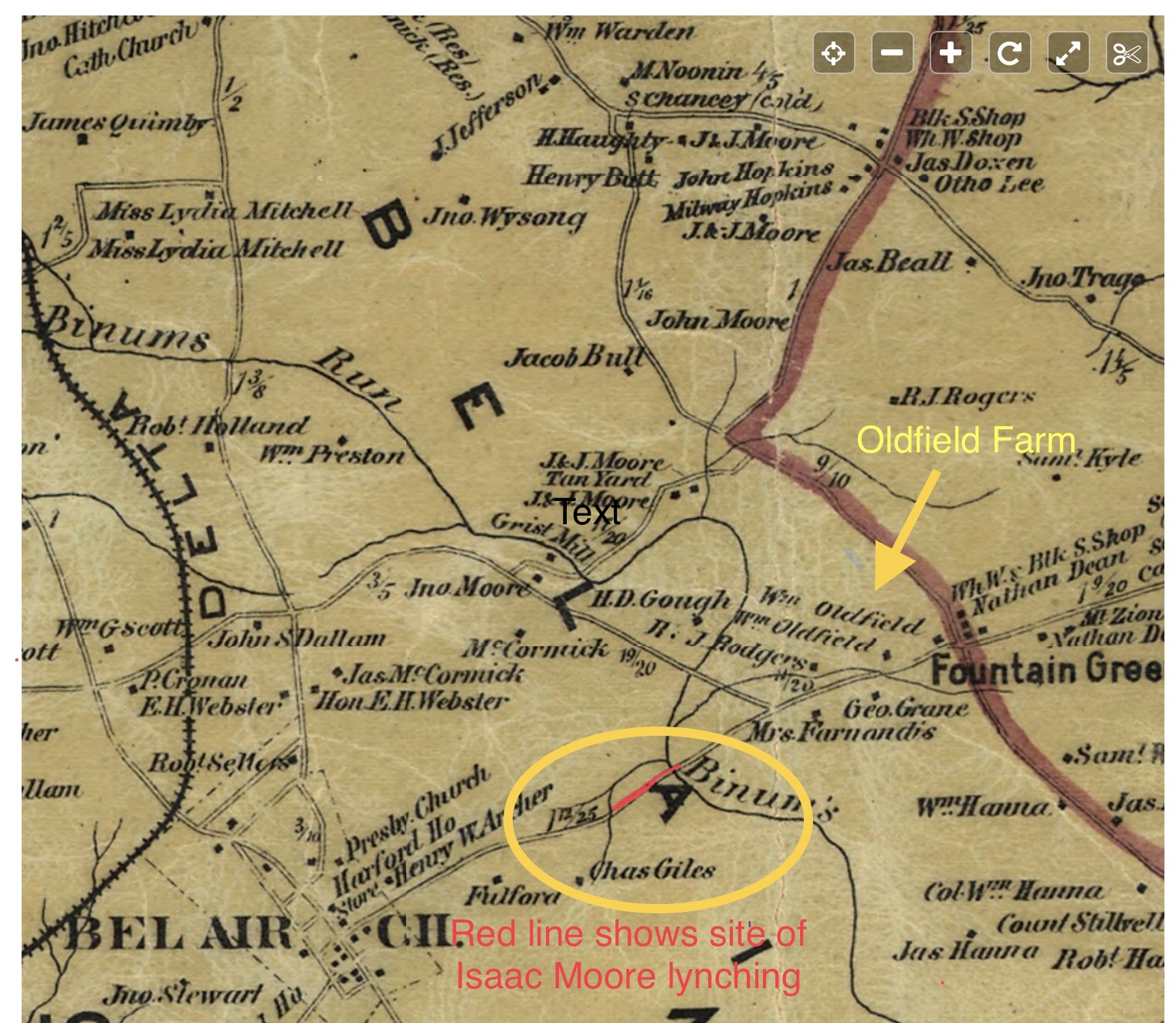
In the case of Isaac Moore’s lynching on July 22, 1868, a newspaper article published on July 24, 1868 in the Baltimore Sun quotes a local resident’s fairly detailed description of the site of the assault allegedly committed by Moore, and states that the lynching occurred at the same site. Miss Fanny Oldfield, a young shopkeeper who ran a millinery store on Main Street in Bel Air, was walking to work that morning up the Churchville Road from her home on the farm of her father, Mr. William Oldfield. The Oldfield farm was located on the Churchville Rd, between Moores Mill Rd. and Fountain Green Rd. Per the newspaper report, when she was “near the little stream nearly opposite Giles’s, and at the foot of the steep hill” she was attacked by two men. This description places the site of the attack on Churchville Rd. near the edge of the property where the John Carroll School is located, and adjacent to Rockfield Park. The 1878 Martenet map shows that at least a portion of that land belonged to a man named Charles Giles. The unnamed reporter, who wrote the article which cites this local account, placed the attack and lynching location “near Bynum’s Run bridge on the Church Hill [sic] road,” which is about 1/4 mile from the site described later on in the article. Another report comes from a minister in Bel Air, who wrote in his diary on July 25th that while out on some business he visited the Booth home (presumably Tudor Hall) and passed by the site where Moore was hanged. In its July 24, 1868 edition , the Aegis and Intelligencer also published a story about the lynching, which provided few details about the actual location, but did state that it occurred at the same site as the reported assault.
 |
Mar-tenet, S. J., McNabb, J. W. & Harford County . County Surveyor. (1878) Martenet's Map of Harford County, Maryland: shore lines and tide water from U.S. Coast Survey, the county from actual surveys. Baltimore: Simon J. Martenet. [Map] Retrieved from the Library of Congress, https://www.loc.gov/item/2002624008/.
Below is a current map showing the locations labeled above:
 |
| Google maps |
While we will probably never know the precise spot where Isaac Moore was lynched, comparing these historic and current maps has allowed us to determine the general location. They also show that, as stated in accounts of the lynching, a man accused but never tried for a crime had a noose placed around his neck and was carried, struggling, a mile from the courthouse in broad daylight by a crowd of townspeople and hanged naked from a tree by the side of a major public road. There are no records to indicate that anyone was ever held accountable for this murder, but, rather, it was defended both publicly and privately as a justifiable punishment for his presumed offense. When the time comes, we will pay past due respect to Isaac Moore by collecting soil from the site of his lynching, and remembering his life.
|