Wednesday, March 30, 2022

Harford County Remembers Lynching Victims with Soil Collection Ceremony


BEL AIR, March 26, 2022 – On this blustery Saturday morning, nearly 200 people of all races and ages gathered at Shamrock Park in Harford County for a Remembrance and Soil Collection Ceremony. A diverse coalition of community members had come together on this chilly, early spring morning to honor the memory of three Black men who were victims of racial terror lynchings in Harford County. 
   Soil jars for Isaac Moore, Jim Quinn and Lewis Harris

Between 1868 and 1900, three men – Isaac Moore, Jim Quinn, and Lewis Harris -- were accused of assaulting white women, taken from police custody, seized by angry white mobs, and hanged. Their brutal murders at the hands of angry mobs are a part of the county’s history that has been largely ignored and forgotten---until now.

The ceremony took place not far from where Lewis Harris was murdered 122 years ago. On March 26, 1900, a mob seized Mr. Harris at the jail on Main Street and took him to the gates of the nearby Archer Farm. There they hanged him from a Poplar tree and shot him numerous times.

Dr. Iris Leigh Barnes, chair of the Harford County Committee of the Maryland Lynching Memorial Project (HarCo MLMP), remarked that she has spent most of her life in Harford County and was proud of it, but “it is not perfect” and the legacy of racial terror lynchings lingers. “It is important to see that these victims were people—fathers, brothers, and husbands,” she noted. “There are always long-term negative impacts of a lynching…not just for the victims, but for their families, their respective communities, and the greater community-at-large. No one goes unaffected.” 

Will Schwarz, president of the Maryland Lynching Memorial Project, discussed the importance of recognizing the truth about racial terror lynchings, and said that we have an obligation to understand how the impact of this racial terrorism continues to manifest itself today, reinforcing themes of Black inferiority and white supremacy. As Mr. Schwarz stated, “You don’t have to be a racist to perpetuate white supremacy.”

As a gesture of respect to the lynching victims, attendees participated in a soil collection ceremony. The Equal Justice Initiative (EJI) of Montgomery, AL, collects jars of soil from places where racial terror lynchings occurred. The jars provide a tangible way to memorialize and hold the stories of African American lynching victims and communities impacted by such violence. As EJI’s Director Bryan Stevenson states:  “In this soil is the sweat of the enslaved. In the soil there is the blood of victims of racial violence and lynching. There are tears in the soil from all those who labored under the indignation and humiliation of segregation. But in the soil there is also the opportunity for new life, a chance to grow something hopeful for the future.”

When Elliot Spillers, EJI Project Manager, stepped to the microphone, he took a long, deep breath and paused for a reflective moment of silence. Shortly afterward, the strong, powerful voice of Minister Eva Taylor of Zion Temple Church filled the morning air, singing “I Am Free.” As the song resonated throughout the park, participants quietly lined up, some with tears in their eyes, to scoop soil into several jars with the names of the three men permanently printed on them. This soil had been collected earlier from previously unmarked places in Harford County where the murders occurred. Officers from the Bel Air Police Department and the Sheriff’s Office Honor Guard stood at attention, paying homage and symbolically providing protection, as the solemn jar-filling ceremony continued.

A jar for each victim will go to EJI’s National Memorial for Peace and Justice. The committee also presented jars to the Historical Society of Harford County and the Hosanna School Museum for educational exhibitions and safekeeping.

Under the direction of Soil Collection Sub-Committee Chair Roxann Redd Wallace, the ceremony also included biographies of the lynching victims; recitations from local youth; a recording of Billie Holiday’s classic song about lynching, “Strange Fruit;” remarks from Harford County Executive Barry Glassman, Bel Air Mayor Kevin Bianca; words and proclamations from the Harford County Council presented by Councilmen Curtis Beulah and Andre Johnson; and participation from several local Girl Scout troops and members of Free State Challenge Academy.

Rev. Ricardo Burns of St. James AME Church Gravel Hill closed this day of remembrance and reconciliation with a prayer. Afterward, Ms. Natasha Jackson delivered a moving rendition of the Negro National Anthem, “Lift Every Voice and Sing.”

Those in attendance agreed that it was a moving, thought-provoking, emotional ceremony---the first step in acknowledging the dark, painful truths of our shared history as we move towards healing and reconciliation through continued, honest conversation. The lives of Harford County’s known victims of racial terrorism --- Lewis Harris, Jim Quinn, and Isaac Moore --- have been forever memorialized.

The HarCo MLMP is preparing for next steps, which include a historical marker; a public-school essay contest with scholarship awards; and a public hearing led by the Maryland Lynching Truth and Reconciliation Commission. If you are interested in donating towards these efforts and/or getting involved, visit Maryland Lynching Memorial Project and EJI for more information.  Also, if you are a descendant of a lynching victim, perpetrator, or witness, please contact us so that we may add to our research.  
 
Donna Lewis, Hosanna School Museum, and Elliott Spillers, EJI receive soil for safe keeping and display at their respective museums.

Bel Air Police Officer O'Grady carries the soil to the collection table.


Cadet Mahki Bennet secures the US flag on the blustery morning, ensuring the colors did not hit the ground!


 For more photos see the Harford County Album on Google Photos or view the slide show below


Tuesday, February 8, 2022

Harford County Committee sets Remembrance Ceremony and Soil Collection for March 26

The Harford County Committee of the Maryland Lynching Memorial Project will hold a Remembrance Ceremony and Soil Collection to honor the victims of the three known racial terror lynchings who were murdered in Harford County:

Isaac Moore (d. July 22, 1868)
Jim Quinn (d. October 2, 1869)
Lewis Harris (d. March 26, 1900)

The event, originally scheduled for 2020, is being held in cooperation with the Equal Justice Initiative on the anniversary of the lynching of Lewis Harris in Bel Air in 1900.

The event is free to the public, but registration is encouraged. You can register by clicking this link.


Monday, May 10, 2021

Governor Hogan Pardons Three Harford County Victims of Lynching

"Gov. Larry Hogan on Saturday issued full posthumous pardons for 34 victims of racial lynching in Maryland between 1854 and 1933. The pardons come on the basis that the extrajudicial killings violated fundamental rights to due process and equal protection of law. The governor spoke Saturday at an event in Towson to honor the life of a boy killed because of the color of his skin. . . ."
 
The pardons included three Harford County Men:

Isaac Moore, who, as he was being taken to a hearing before a Bel Air magistrate, was seized by a mob and lynched on or about July 22, 1868, a PARDON as to the allegations of assault, robbery, and attempted rape for which he was arrested;
 
Jim Quinn, who was taken from a train in or near White Hall by 30 men and lynched from a nearby tree on or about Oct. 2, 1869, a PARDON as to the allegations of assault for which he was committed to jail;  

Lewis Harris, who was seized from jail by a mob, hanged, and shot in or near Bel Air on or about March 27, 1900, a PARDON as to the allegations of assault for which he was arrested;
 

Wednesday, October 14, 2020

Third Annual Conference of the Maryland Lynching Memorial Project

 The third annual conference of the Maryland Lynching Memorial Project.

The Maryland Lynching Memorial Project's annual "Lynching in Maryland" conference will be held online this year due to the ongoing public health emergency. This will be the third year we have presented this program.

This year's conference will be held:

Saturday, October 17, 2020
10a to 12.30p.

One of this year's keynote speakers will be Michael Pfeifer, Ph.D., Professor of History at the John Jay College of Criminal Justice and the Graduate 

For more information on the Maryland Lynching Memorial Project visit the organizations webpage


Monday, September 28, 2020

NPR Interviews Dr. Charles Chavis Jr., of the Maryland Lynching Trut and Reconciliation Committee

NPR's Ailsa Chang talks to Charles Chavis Jr. of the Maryland Lynching Truth and Reconciliation Commission, which is beginning its two-year investigation of the state's harrowing history of lynching.

Click here to listen to the interview that aired on NPR's new show, All Things Considered, on September 28, 2020.

Sunday, May 31, 2020

Take a Knee for Justice -- Sunday, May 31, 2020


May 31, 2020

To the friends of the Maryland Lynching Memorial Project:

The Maryland Lynching Memorial Project (MD LMP) is organizing a brief, silent and peaceful gathering in Towson today, Sunday, May 31, 2020 at 3.00p to demonstrate our solidarity with George Floyd and other black victims of racial terror.

At 3.00p sharp, we will ask all who have gathered to “take a knee” and remain kneeling for 9 minutes, which represents the amount of time former Officer Derek Chauvin applied lethal force to the neck of Mr. Floyd. The program will conclude at the end of the nine minutes.

We ask all who wish to attend this action to wear a face mask and observe social distancing guidelines out of consideration for your neighbors. Also, any signs must be hand-held ONLY!

A flyer with additional details is attached to this message.

Thanks for your consideration.

Best,
Will

Wednesday, May 20, 2020

Identifying the Sites of Lynchings in Harford County


Part of the Harford County Committee of the Maryland Lynching Memorial Project’s effort to commemorate the lives of three men known to have been lynched in Harford County involves collecting jars of soil from the lynching sites. Some of these soil samples will be sent to the Legacy Museum in Montgomery, Alabama to be placed alongside soil collected from lynching sites around the country in a memorial display for the thousands of victims of racial terror lynching in the United States. Other soil collection jars will remain in Harford County to be displayed locally. The Soil Collection and Remembrance Ceremony scheduled for March 28, 2020 in Bel Air was postponed due to the Covid 19 outbreak, but will be rescheduled once it is determined to be safe again to hold public gatherings. While it is not essential, or even possible, to gather soil from the exact spots where the lynchings occurred, we feel it is important to come as close as we can, both to maintain historical accuracy and to honor these men.


In Harford County, our researchers have used a variety of sources to try to pinpoint these sites. Historically, some lynchings were conducted in relative secrecy, but others took place quite publicly, often in broad daylight with crowds of onlookers. Newspapers and witnesses often left detailed descriptions of the events and their locations. However, unless there are physical landmarks still intact at those sites, it can be difficult to determine the location accurately from the descriptions alone. One very helpful tool has been the use of historic maps, especially those from the 1800s. In Harford County, the Jennings and Herrick map from 1858, the Martenet’s map from 1878, election maps from the 1920s, and fire insurance maps from the 1930’s have all proven useful, especially when compared with early aerial photographic surveys of the county, particularly those from 1938 and 1952. Landmarks provided by descriptions of the events can often still be seen using these sources, even though they may have since disappeared due to development in the county. The process of utilizing various sources to corroborate first person descriptions is a good historical research technique, which helps confirm the validity of our findings.


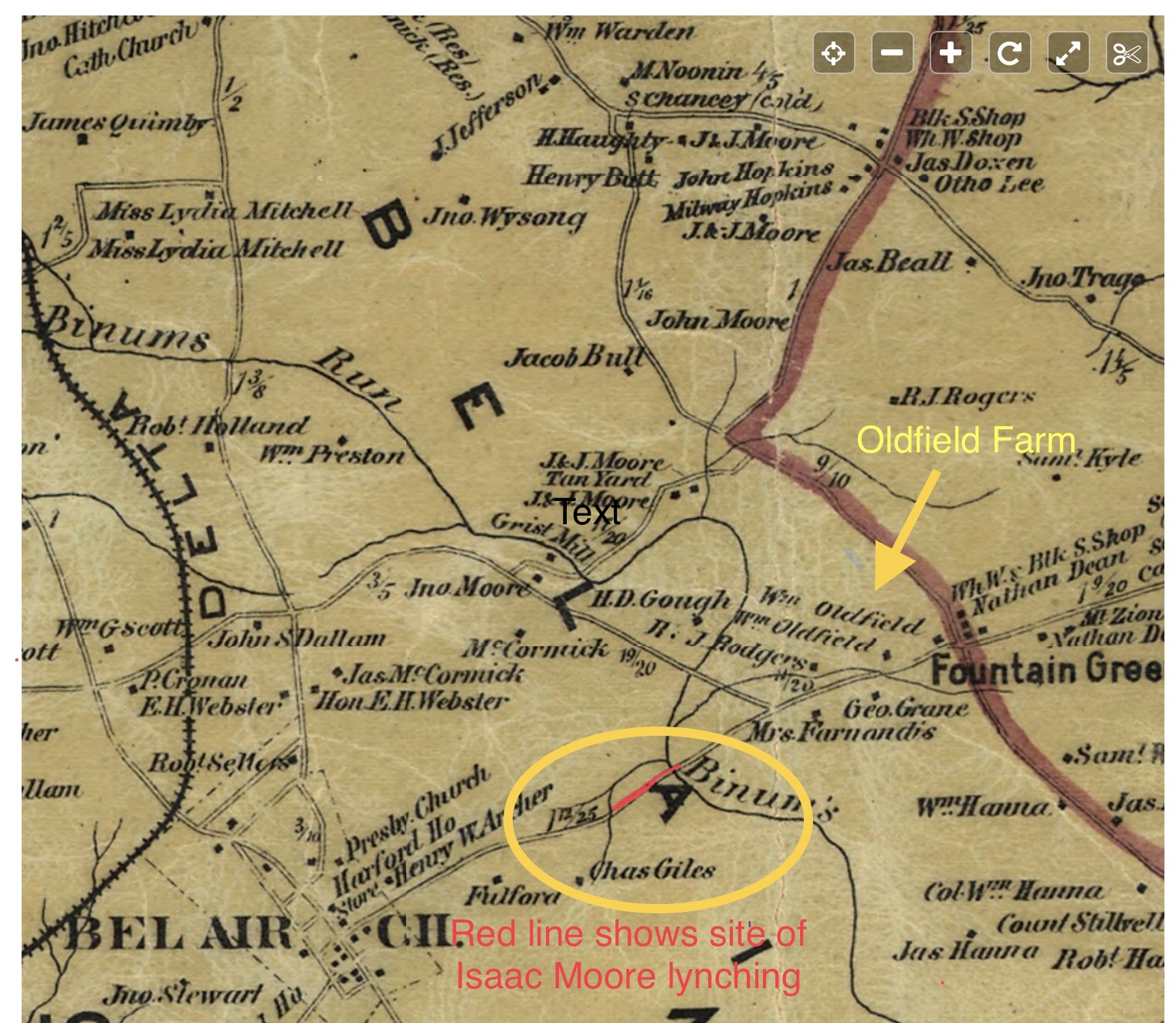
In the case of Isaac Moore’s lynching on July 22, 1868, a newspaper article published on July 24, 1868 in the Baltimore Sun quotes a local resident’s fairly detailed description of the site of the assault allegedly committed by Moore, and states that the lynching occurred at the same site. Miss Fanny Oldfield, a young shopkeeper who ran a millinery store on Main Street in Bel Air, was walking to work that morning up the Churchville Road from her home on the farm of her father, Mr. William Oldfield. The Oldfield farm was located on the Churchville Rd, between Moores Mill Rd. and Fountain Green Rd. Per the newspaper report, when she was “near the little stream nearly opposite Giles’s, and at the foot of the steep hill” she was attacked by two men. This description places the site of the attack on Churchville Rd. near the edge of the property where the John Carroll School is located, and adjacent to Rockfield Park. The 1878 Martenet map shows that at least a portion of that land belonged to a man named Charles Giles. The unnamed reporter, who wrote the article which cites this local account, placed the attack and lynching location “near Bynum’s Run bridge on the Church Hill [sic] road,” which is about 1/4 mile from the site described later on in the article. Another report comes from a minister in Bel Air, who wrote in his diary on July 25th that while out on some business he visited the Booth home (presumably Tudor Hall) and passed by the site where Moore was hanged. In its July 24, 1868 edition , the Aegis and Intelligencer also published a story about the lynching, which provided few details about the actual location, but did state that it occurred at the same site as the reported assault.

Mar-tenet, S. J., McNabb, J. W. & Harford County . County Surveyor. (1878) Martenet's Map of Harford County, Maryland: shore lines and tide water from U.S. Coast Survey, the county from actual surveys. Baltimore: Simon J. Martenet. [Map] Retrieved from the Library of Congress, https://www.loc.gov/item/2002624008/.


Below is a current map showing the locations labeled above:


Google maps

While we will probably never know the precise spot where Isaac Moore was lynched, comparing these historic and current maps has allowed us to determine the general location. They also show that, as stated in accounts of the lynching, a man accused but never tried for a crime had a noose placed around his neck and was carried, struggling, a mile from the courthouse in broad daylight by a crowd of townspeople and hanged naked from a tree by the side of a major public road. There are no records to indicate that anyone was ever held accountable for this murder, but, rather, it was defended both publicly and privately as a justifiable punishment for his presumed offense. When the time comes, we will pay past due respect to Isaac Moore by collecting soil from the site of his lynching, and remembering his life.